Choosing Egyptian marble for your home is a decision that surprises a lot of clients once they realize how strong the local stone actually is. Egypt has been a marble and limestone producing country for thousands of years, quarries around Sohag, Minya, and the Eastern Desert still supply stone that shows up in projects across the region, and using it in a Cairo home is not a compromise against imported Italian or Greek marble so much as a genuinely different, often better, option depending on the project.
This kind of decision comes up constantly in our Residential Interiors projects across Cairo, and it is usually worth settling early rather than late.
The appeal is not only patriotic. Local marble travels a fraction of the distance an imported slab does, which lowers cost, reduces the breakage risk that comes with long shipping routes, and shortens lead times meaningfully, sometimes cutting weeks off a schedule that an imported order would otherwise hold up.
Why Local Sourcing Actually Matters for Cost and Logistics
Imported marble carries shipping cost, import duty, and a real risk of damage in transit that gets priced into the slab whether or not a crack actually happens on your specific order. Egyptian marble skips most of that. A slab quarried in Upper Egypt can reach a Cairo stone yard within days rather than the weeks or months an imported container takes, and the pricing reflects that shorter, simpler supply chain.
This matters most on larger projects, a full villa floor or a kitchen island slab, where the cost difference between local and imported stone compounds across dozens of square metres rather than showing up as a rounding error on a small bathroom vanity.
Choosing Egyptian Marble for Your Home Means Knowing the Varieties
Egyptian marble is not one material, it is a family of stones with distinct character. Galala marble, quarried from the Galala plateau, has a warm beige to cream base with soft veining that reads well in both traditional and contemporary interiors. Sinai marble tends toward pink and rose tones that work beautifully as an accent rather than covering an entire room. Halayeb marble runs closer to white with grey veining, closer in appearance to the Carrara most people picture when they think of marble at all.
Each variety behaves a little differently in terms of porosity and veining consistency, which is exactly why seeing an actual slab in person, not a photo or a small sample tile, matters before committing to a full order.
How to Actually Inspect a Slab Before You Buy
Never order marble from a catalogue image alone. Veining, tone, and even the degree of natural variation between slabs from the same quarry batch can differ enough to change how a finished room reads. Visiting the stone yard, ideally with your designer, to select the specific slab or slabs your project will use is the single most important step in the whole process.
- Check for hairline cracks by tilting the slab under raking light rather than looking straight on
- Confirm veining direction and match it across slabs that will sit side by side in a large floor or wall
- Ask for a wet sample, since marble darkens and veining becomes more visible once sealed and polished
- Compare slabs from the same batch, since even Egyptian marble from one quarry varies visibly between blocks
A marble floor is only as good as the slab it was actually cut from, and no two slabs, even from the same quarry, are quite the same.

This pairs naturally with a related decision we cover in Choosing Interior Doors and Hardware in Cairo Homes.
Where Egyptian Marble Fits Best in a Cairo Home
Entryways, kitchen islands, and bathroom vanities are the classic applications, and Egyptian varieties handle all three well. Galala marble in particular has become a favourite in New Cairo and Sheikh Zayed villas for entry flooring, where its warmer tone suits the strong natural light those homes typically get through larger windows and higher ceilings than an older Zamalek or Heliopolis apartment would have.
Kitchen countertops need more caution regardless of origin, marble etches from acidic spills and stains from oil, so even locally sourced stone benefits from a honed finish and a good sealant if it is going to see daily cooking use rather than serving a mostly decorative role.
Sealing and Maintenance Specific to Egyptian Stone
Egyptian marble varieties generally require the same sealing schedule as any natural marble, roughly once a year in a high traffic area and every eighteen months to two years somewhere gentler like a guest bathroom. Cairo’s dust is abrasive enough over time that regular sweeping before mopping matters more here than in a less dusty climate, since grit ground into a wet mop can dull a polished surface faster than expected.
Common Mistakes We See
The biggest mistake is assuming local automatically means lower quality, which is simply not true of Egypt’s better quarries. The second is skipping the slab viewing step to save time, then being surprised when the installed floor does not match the small sample seen months earlier. The third is choosing a polished finish for a busy kitchen floor when a honed or leathered finish would hide daily wear far better.
What Changes the Brief for a Stone Surface
How the room is actually used
A guest bathroom and a family kitchen ask very different things of the same stone. Before choosing a variety, describe who walks on it, who cooks on it and how often it gets wet. That description decides the finish more than the colour does.
The size of the surface
A single vanity top may come from one slab. A full floor needs many, and the more slabs involved, the more important matching becomes. Tell the designer early how much stone the brief really needs, so the selection can be planned rather than improvised.
Light and surroundings
Stone looks different under warm bulbs, cool bulbs and daylight. Look at the slab in the kind of light the finished room will have, and keep the wall colours and joinery tones in mind while you do.
Planning Order and Lead Times for Stone
Choose the stone before the cabinets and fittings
Sink cut outs, hob positions and tap holes are all measured against the final slab. If the cabinets are built first and the stone changes later, something usually has to be redone.
Templates and cutting
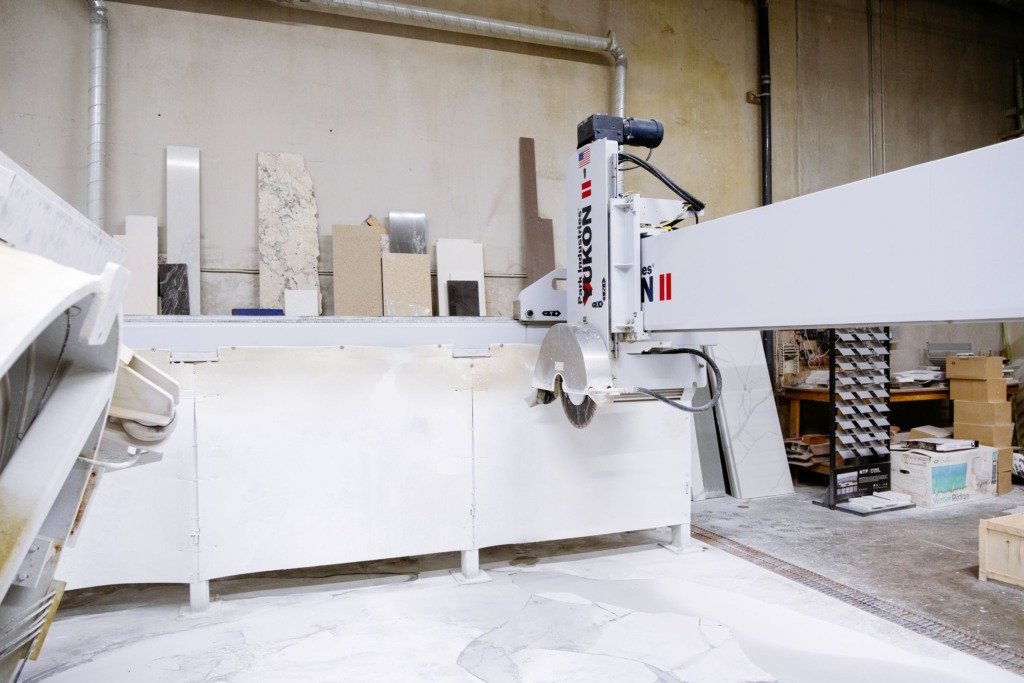
Stone is usually cut to a template taken on site once the cabinets are fixed. That step needs a clear window in the schedule, and nobody should be moving cabinets while it happens.
Ordering against the schedule
Even local stone needs time to be selected, cut, finished and delivered. Ask the yard for its realistic lead time and place the order against the construction schedule, not on the day the room is ready.
Comparing Stone Quotes Fairly
Check that the specification matches
Quotes are only comparable when they describe the same variety, thickness, finish and edge profile. A lower total can simply reflect a thinner slab or a plainer edge.
Ask what is included
- Cutting and polishing of edges
- Delivery to the building and carrying to the floor
- Installation and any fixing materials
- Sealing at handover
- Protection of the stone until the site is cleaned
Keep the written quote with the slab you chose
Photograph the slabs you select, with their identifying marks, and ask for those marks to be written on the order. That way the stone that arrives is the stone you approved.
What to Prepare Before You Visit the Stone Yard
- Plans with the surfaces that need stone marked clearly
- Photos of the room and any fixed finishes beside it
- Samples of paint, wood or tile the stone will sit next to
- A list of questions about maintenance and finish
- Comfortable shoes, since a yard is a working site
If you live abroad, a designer can visit the yard on your behalf and send photographs and short videos of each slab under natural light, so you can approve the choice from wherever you are.
Frequently Asked Questions
Is Egyptian marble suitable for a kitchen worktop?
It can be, with a honed finish and proper sealing. Like any marble it can etch and stain, so it suits households that accept some natural ageing.
Should I choose from a sample tile or a full slab?
Choose from the full slab whenever you can. A small sample cannot show the veining pattern or the natural variation across a larger piece.
Can I mix marble with other materials in one room?
Yes. Stone often works best as one feature surface beside timber, paint or tile, rather than covering every surface.
Who should be present when the stone is installed?
Ideally the designer or a representative, to check the veining direction and the joints against the approved slabs before they are fixed.
Choosing Egyptian marble for your home is very often the financially and logistically smarter decision without sacrificing quality, provided you take the time to select the specific slabs in person rather than ordering sight unseen from a catalogue.
We sourced Galala marble directly from a stone yard for the entry and staircase treads on Villa Basement Spa & Pool, one of several material decisions made as part of the full Residential Interiors scope for that home, and if you are still weighing marble against other flooring options room by room, Choosing Flooring for a New Cairo Apartment covers that comparison in more depth.

Free guide
Choosing Materials That Last in a Cairo Home
Leave your details and we will email you the guide on this subject straight away.
One guide, no repeat mailings.
Your guide is on its way
Check your inbox in a few minutes. If it is not there, look in your spam folder.