Bathrooms are the most punishing rooms in a house. Constant water, steam, temperature swings, cleaning products and daily abrasion, all applied to surfaces chosen largely because they looked good in a showroom. Five years later the difference between a considered specification and an attractive one is very easy to see.
What follows is how the studio actually chooses bathroom materials, and what tends to go wrong.
Natural stone: beautiful, and conditional
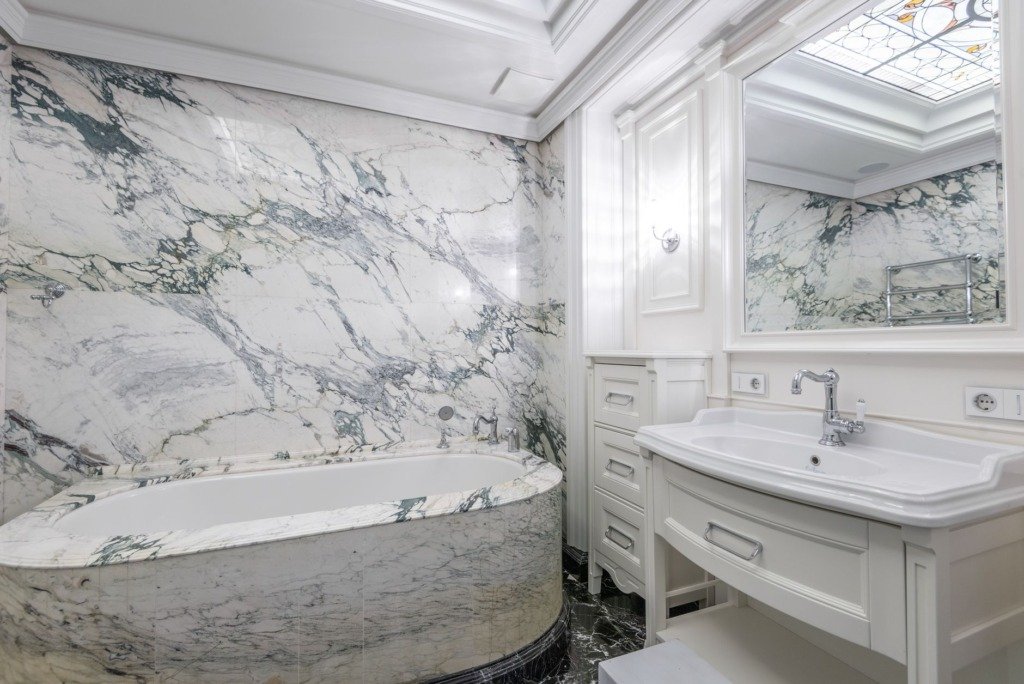
Marble is the material everyone asks for, and it can be the right answer. It is also porous, reactive to acid, and softer than most people assume.
- It will etch. Shampoo, toothpaste, citrus and limescale remover all leave dull marks on a polished surface. Honed finishes hide this far better than polished ones.
- It needs sealing. On installation and then periodically. This is maintenance, not a one-off.
- It has a grain. Slabs vary. Choose the actual slab, and ask for it to be book-matched if the veining is the point.
Used on a vanity top or a feature wall, marble ages into something better. Used across a heavily shared family shower floor, it becomes a chore.
Porcelain has closed the gap
Large-format porcelain is now good enough that the argument for stone is aesthetic rather than practical. It is non-porous, needs no sealing, does not etch, and comes in slabs big enough to reduce grout lines to almost nothing.
The tell is repetition. Cheaper ranges use three or four printed faces, so the same veining recurs across a wall and the eye picks it up immediately. Better ranges use dozens of variations. Ask how many faces are in the range before specifying it.
Choose the finish for where your hands and feet go, and the material for where your eyes go.
Floors: slip resistance is not optional
Polished stone or gloss porcelain on a wet bathroom floor is a genuine hazard, and it is specified constantly because it photographs well.
- Look for an R10 rating as a minimum on a bathroom floor, and R11 inside a wet room or shower
- Smaller formats inside a shower give more grout lines and therefore more grip
- Honed, textured or structured finishes are safer than polished, and hide watermarks better
Grout and silicone decide how it ages
Nothing dates a bathroom faster than discoloured grout. Two decisions prevent it.
First, use an epoxy grout in wet areas. It costs more and takes longer to install, and it does not stain or harbour mould the way cement grout does. Second, choose a grout tone close to the tile rather than a contrast, so that any variation over time is invisible instead of graphic.
Silicone is a consumable. Plan on replacing it every few years and it will never be a problem.
Specify epoxy grout in the shower and a honed rather than polished floor finish. Those two decisions account for most of the visible difference between a five-year-old bathroom that looks cared for and one that looks tired.
Brassware: the finish matters more than the shape
Taps and showers are handled every day with wet hands, so the coating is doing real work.
- Chrome is the most durable and the easiest to live with. It shows watermarks and cleans instantly.
- Brushed nickel and brushed brass hide marks well and age gracefully, provided the finish is PVD rather than a lacquer.
- Matt black looks superb and shows limescale badly in hard water. Consider where the water is coming from before committing.
- Living finishes such as unlacquered brass will patinate. That is the point, but the client has to want it.
Timber, if it is detailed properly
Timber brings warmth that no tile achieves, and it survives a bathroom perfectly well when it is kept out of direct spray, sealed on all six faces including the hidden ones, and paired with real extraction. Vanity units, screens and slatted panels are all reasonable. Shower floors are not.
Extraction, again
Almost every bathroom material failure traces back to moisture that had nowhere to go. An adequately sized extract fan with a run-on timer, ducted outside rather than into a void, protects every other decision on this page.
Specifying a bathroom?
If you have a moodboard and a shortlist of tiles, that is a good moment to get a second opinion before the order goes in. Send them over and we will tell you which choices will still be working in five years.