
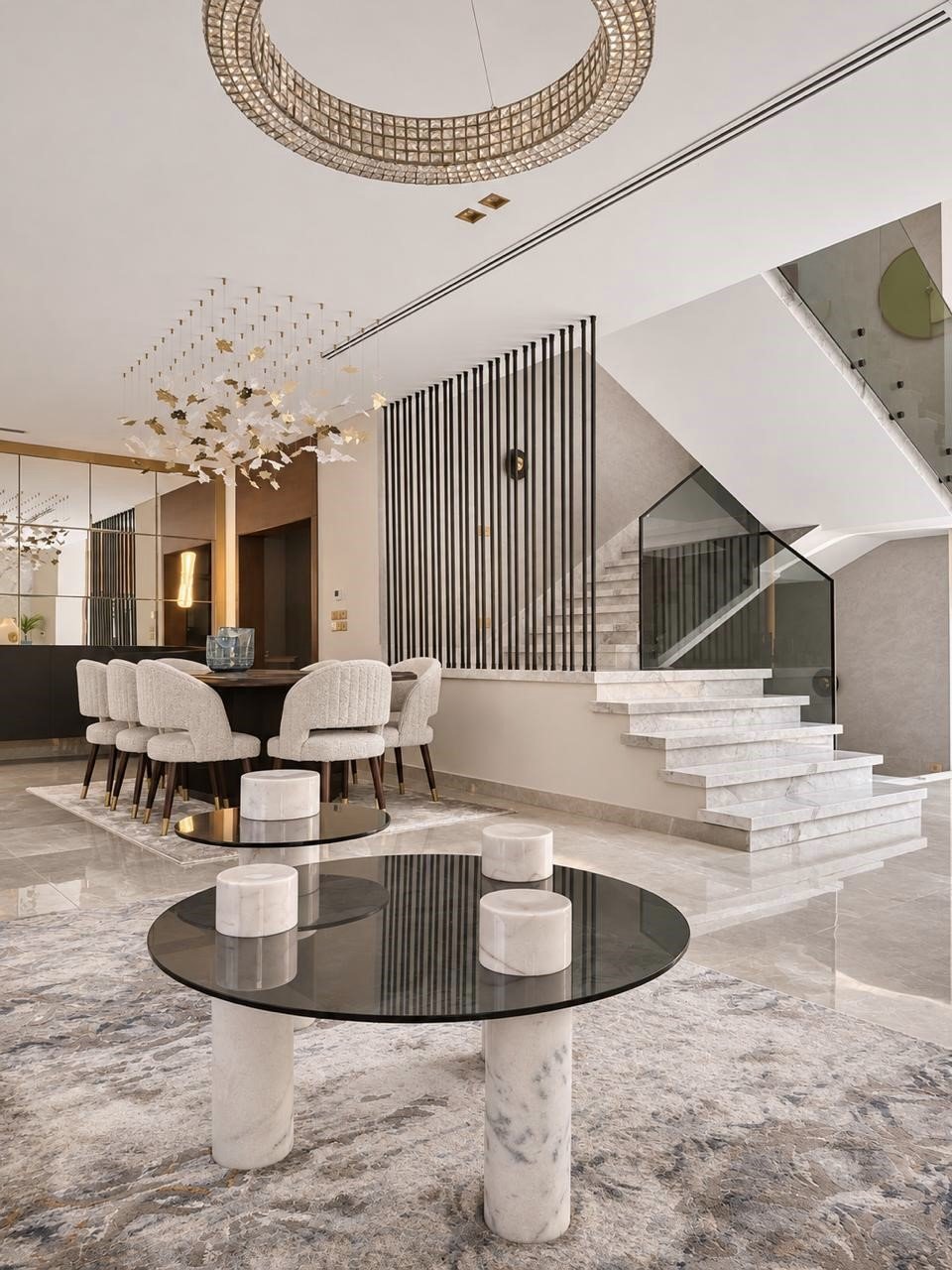
The living room is the hardest working room in most Cairo homes: it hosts daily family life, receives guests, and often absorbs the TV, the seating, and the flow through to the rest of the home all at once. Designing it well is less about a single look than about resolving how it is actually used, where people sit, what the room points toward, how it is lit through the day and evening, and how people move through it without cutting across the conversation. Get those right and everything else follows.
It is the kind of work we handle as part of Residential Interiors on homes across Cairo and New Cairo.
Most living rooms that feel wrong are not badly decorated so much as badly arranged: seating that does not talk to itself, a room with no clear focus, or a single harsh ceiling light doing all the work. These are layout and lighting problems, and they are what a good design fixes first.
Seating and Layout
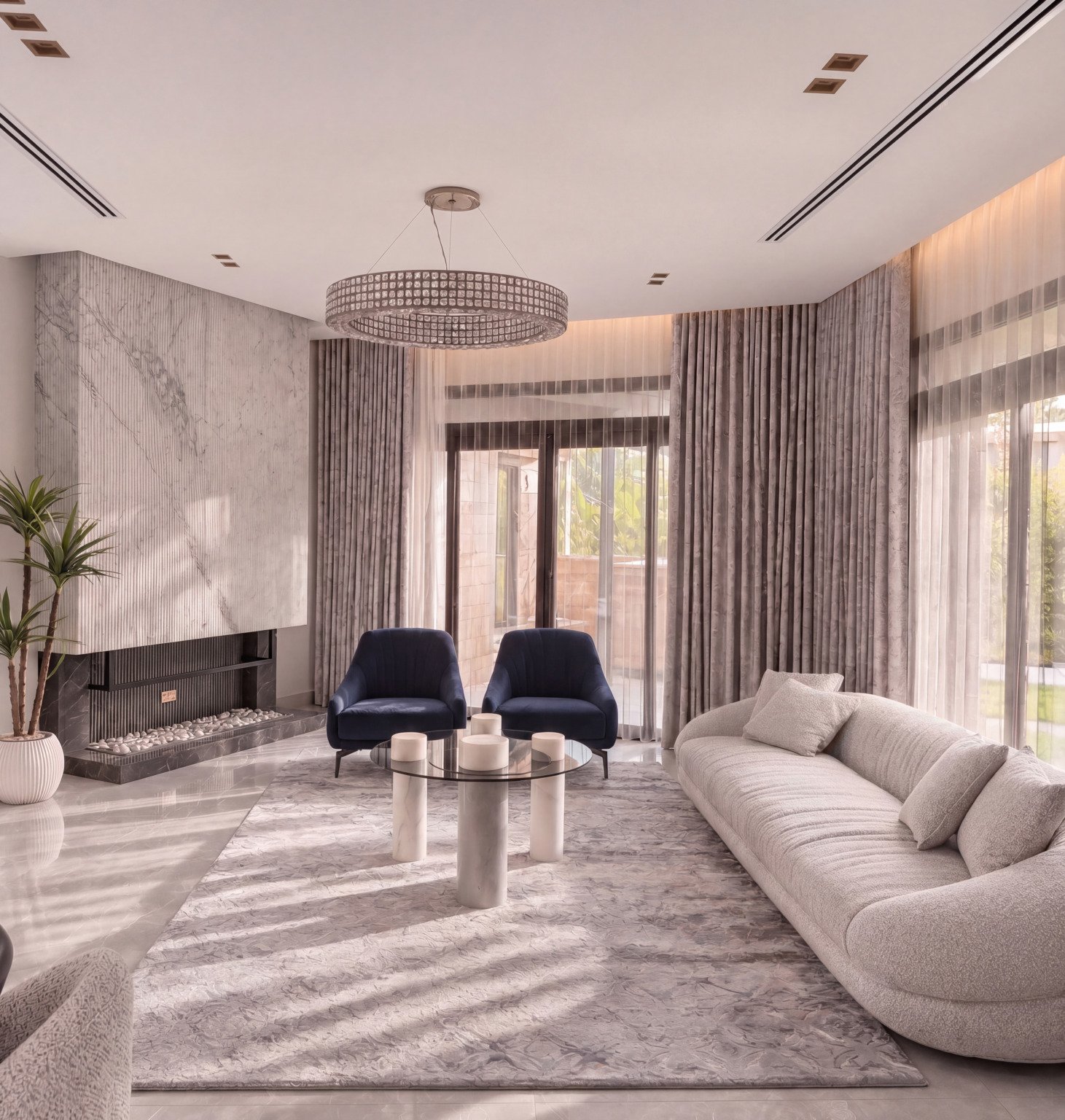
The heart of a living room is how the seating is arranged, because that is what decides whether the room feels sociable or awkward. Seats that face each other at a comfortable conversational distance, a clear route through the room that does not cut between them, and a layout scaled to the actual space rather than crammed or lost in it are the foundation. In a Cairo home that regularly hosts guests, the arrangement also has to flex from everyday family use to a larger gathering without being rebuilt each time.
- Seating arranged to face inward at a comfortable conversational distance
- A clear circulation path that does not cut through the seating group
- Furniture scaled to the room, neither cramped nor lost in the space
- An arrangement that flexes from daily family use to hosting guests
A Clear Focal Point
Every living room needs something to anchor it, and deciding what that is early prevents the common trap of a room pulled in two directions. Whether the focus is a television, a feature wall, a view, or a fireplace, the seating and the layout should agree on it rather than competing. A room with one clear focal point feels calm and intentional, while one that tries to face the TV and the view and the door at once always feels slightly unresolved.

For a closer look at a related piece of the puzzle, see Layered Lighting for a Cairo Living Room.
Layered Lighting
A living room is used from bright afternoons to late evenings, so it needs light that can change with the time of day. A single ceiling fixture cannot do that: the room wants layers, ambient light for general use, softer lamps for the evening, and accents that pick out a feature or a corner. Layered lighting is what lets one room feel bright and practical by day and warm and relaxed at night, and it is the layer most Cairo living rooms get wrong.
- Ambient ceiling or cove light for general daytime use
- Softer floor and table lamps for a warm evening mood
- Accent lighting to pick out a feature wall, art, or a corner
- Dimming or switching so the room can shift from day to evening
Materials, Colour, and Comfort
Because the living room takes the most daily use of any room, its materials and colours have to be as practical as they are attractive. Hard wearing upholstery, surfaces that handle everyday life, and a palette that stays calm as the room fills with people and objects all keep it looking good over time. Comfort matters as much as looks here, since a beautiful living room that is uncomfortable to actually sit in has failed at its one main job.
A living room works when the seating talks to itself, the room has one focus, and the light can change with the day.
What Changes the Brief for a Living Room
Who Uses the Room
A room used by young children, by grandparents and by regular guests asks for different things from one used by a couple. Tell us who sits where and when, because that decides the seating, the surfaces and how much open floor the room needs.
The Shape and Size of the Room
A long narrow room, a square room and an open plan space each suggest a different arrangement. The shape and the position of the doors and windows set the limits, and they are worth measuring carefully before any furniture is chosen.
How the Room Connects to the Home
If the living room opens onto the dining area, the entrance or a balcony, the design should treat them as one flowing space. Colours, flooring and lighting that carry across the openings make the whole home feel larger and calmer.
Planning the Order of Work
Layout and Lighting Points First
Decide where the seating and the focal point sit, then position sockets, lighting points and air conditioning to suit. These are hard to move once walls and ceilings are finished.
Joinery and Feature Walls Next
Media units, shelving and panelling are made to measure, so they follow the layout. Hiding cables and storage inside them keeps the room visually quiet.
Furniture, Rugs and Curtains Last
Sofas, rugs and curtains are chosen once the finishes are in place, so colours can be judged in the real light of the room rather than from a small sample.
Materials and Comfort in Cairo Conditions
Sofas and Upholstery
Test the seat depth, the back support and the fabric before you buy. A sofa that looks right but is uncomfortable will be avoided, and a fabric that marks easily will look tired quickly in a busy family room.
Floors, Rugs and Dust
Cairo dust settles on everything, so choose floors and rugs that are easy to clean. A rug also defines the seating area and softens sound, which helps a large room feel more settled.
Sun, Curtains and Glare
- Layered curtains with a light layer for the day and a heavier one for the evening
- Fabrics that resist fading in strong sun
- Placing the television away from direct window glare
- Furniture and artwork kept out of the harshest sunlight
Working Remotely With a Cairo Studio
What to Prepare
- The floor plan with window and door positions
- Clear photographs of the room from each corner
- A note of the furniture you want to keep
- Images of living rooms you like and ones you do not
Approving Designs From a Distance
We share realistic views, layouts and material boards so you can see the room before anything is ordered, and we ask for written approval at each stage.
Comparing Quotes and Lead Times
Compare Like With Like
Ask each supplier to list the same fabrics, finishes and fittings. A low figure may mean a thinner fabric, a lighter frame or a narrower scope.
Allow for Lead Times
Made to measure sofas, joinery and imported lighting take longer than stock items. Order them early and confirm dates in writing so that the room is not left half finished.
Frequently Asked Questions
Where should the television go?
Place it where the seating can face it comfortably and away from window glare. If it is also the focal point, plan the cables and storage around it.
Can I keep some of my existing furniture?
Often yes. We can plan around the pieces you love and replace only what no longer works, which keeps the room personal.
How many lights does a living room need?
There is no fixed number. Aim for several sources at different heights, controlled in groups, so the room can change from day to evening.
Should the living room and dining area match?
They should relate rather than match. Shared colours, materials or lighting tie them together while each space keeps its own character.
When should I start planning?
Before you buy any furniture. Planning the layout and lighting first stops expensive mistakes and makes every later choice easier.
Resolve the seating layout, the focal point, and the lighting before choosing colours or furniture. In a living room, how it is arranged and lit matters far more than any single piece in it.
Planning the Living Room Properly
Because a living room depends on layout, a clear focal point, and layered lighting working together, it rewards planning the whole room before buying anything. Setting the arrangement and the lighting first, then choosing pieces to suit, is what turns a Cairo living room into the comfortable, sociable heart of the home it is meant to be.
We go into a related topic in more depth in Choosing a Sofa That Will Actually Last in a Cairo Home, worth a read alongside this one.
To see the result before anything is ordered, the studio offers 3D interior design in Egypt with realistic views of each room.
Free guide
Choosing Materials That Last in a Cairo Home
Leave your details and we will email you the guide on this subject straight away.
One guide, no repeat mailings.
Your guide is on its way
Check your inbox in a few minutes. If it is not there, look in your spam folder.